
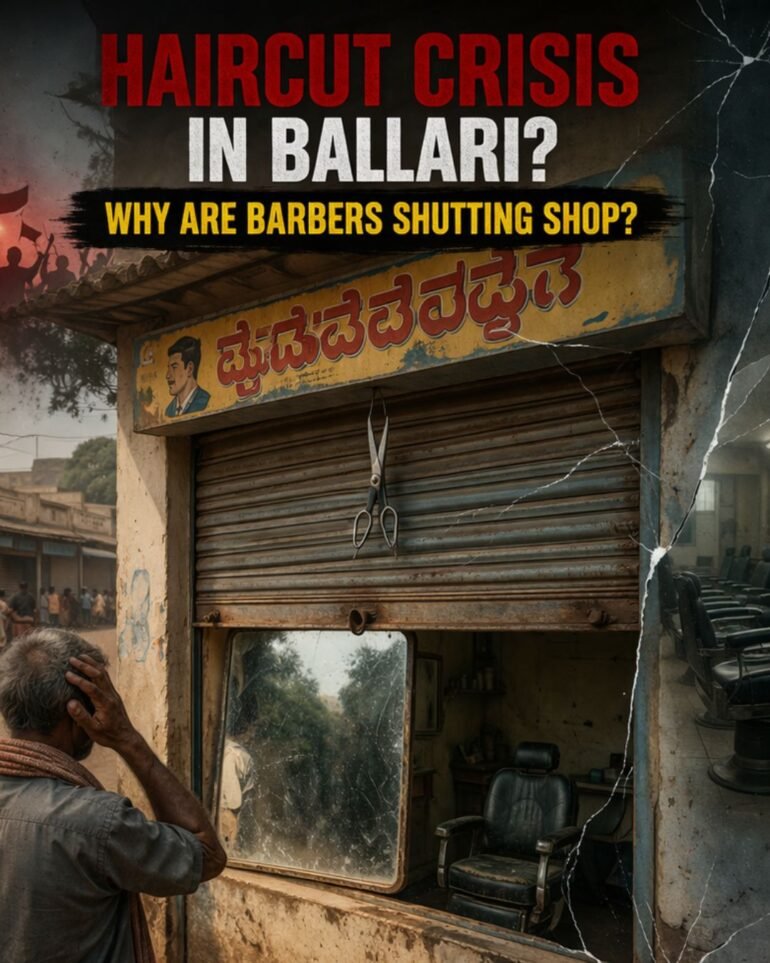
A caste conflict in Ballari has led to an unusual fallout. Barbers across affected areas have shut their shops. Caught between opposing social pressures and the risk of backlash, many have chosen to close rather than take sides, turning a routine service into the center of a much larger issue.
Unlike most professions, barbering involves direct physical contact. In communities where outdated notions of purity and untouchability still linger, this makes their work socially sensitive. A haircut is no longer just a service. It becomes a statement about inclusion, equality, and who is allowed to share common spaces.
At first glance, it may seem like a small, local disruption. But the shutdown points to deeper tensions that continue to exist in parts of rural Karnataka. In several villages, access to everyday services is still influenced by caste dynamics, and barbers often find themselves at the heart of it.
However, the reality for barbers is far more complicated than a simple choice between right and wrong. Most are small, independent workers whose income depends heavily on dominant caste customers in the village. Going against social pressure can lead to boycotts, loss of business, or even threats. On the other hand, refusing service can spark anger and conflict from marginalized communities. Either way, they risk losing.
This is why, in situations like the one unfolding in Ballari, shutting shop becomes a form of self-preservation. It allows barbers to avoid immediate confrontation and protect themselves from being dragged deeper into a conflict they did not create. But this temporary pause also disrupts daily life and highlights how fragile social harmony can be.
What is happening in Ballari is not an isolated incident. Similar patterns have been reported in other parts of North Karnataka, where access to basic services like haircuts has become entangled in caste-related tensions. In some cases, authorities have had to intervene to ensure that such services remain accessible to everyone, underlining the seriousness of the issue.
More importantly, these incidents reveal how economic dependence and social hierarchy continue to shape behavior on the ground. Barbers are not power holders in these situations. They are intermediaries, navigating pressure from both sides while trying to sustain their livelihood. Yet, they become the most visible face of a much deeper problem.

The situation in Ballari is a reminder that while urban spaces may appear more progressive, rural realities often tell a different story. Change is happening, but unevenly, and sometimes only when conflicts bring these issues into the open.
Ultimately, this is not just about barbers or closed shops. It is about dignity, access, and the ability of communities to coexist without discrimination. When something as basic as a haircut becomes contested, it signals that the issue goes far beyond the salon chair.
For now, the focus may be on when the shops will reopen. But the larger question remains: will the underlying tensions be addressed, or will they resurface again, as they have in the past?