
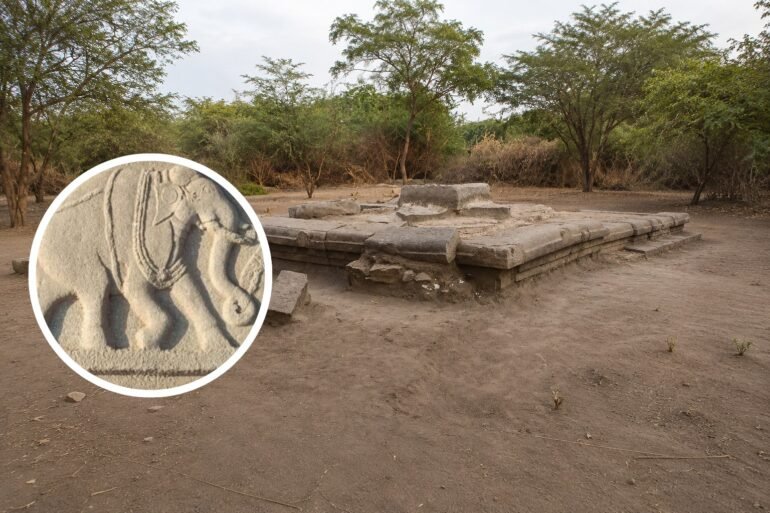
A buried temple structure from the Vijayanagara period has been discovered near the southern gate wall of the Hazara Rama Temple in Hampi, during ongoing restoration work by the Archaeological Survey of India (ASI). The find includes a brick-built shikhara, the top of a sanctum sanctorum, and rare stone carvings of elephants, pointing to a structure that may have stood for centuries before being buried following the destruction of the Vijayanagara capital in 1565.
The structure measures approximately 4.30 metres in length and 4.25 metres in width. ASI officials believe that walls over 10 feet high could still be preserved underground, raising the possibility that a significant portion of the temple remains intact beneath the soil. K. Ramakrishna Reddy, the Archaeological Superintendent of the ASI Hampi Circle, visited the site with his team immediately after the discovery was made.
Officials have provisionally identified the structure as a possible Jain temple, though further excavation will be needed to confirm this. Reddy confirmed that the sculptures and structural elements uncovered so far will be carefully preserved and restored.
V. Virupakshi, State General Secretary of the State Tourist Guides Association, praised the scientific and systematic approach of the ongoing excavation. “This will help reopen the pages of the Vijayanagara Empire’s past glory,” he said.

The discovery is part of a broader excavation effort that ASI has been carrying out along the Pan Supari Bazaar corridor, a one-kilometre stretch near the Hazara Rama Temple that historians believe was once the royal city’s busiest marketplace. The eastern section of Hampi’s royal core has historically received less archaeological attention than its western and southern zones, making recent finds from this area particularly valuable.
Hampi, a UNESCO World Heritage Site located near Hospet in Vijayanagara district, was the capital of the Vijayanagara Empire from 1336 to 1565. The city was sacked by the Deccan Sultanate confederacy in 1565 and largely abandoned, leaving much of it buried under centuries of debris. ASI continues to excavate and document the site, which is estimated to contain around 1,600 monuments spread across 41.5 square kilometres.