
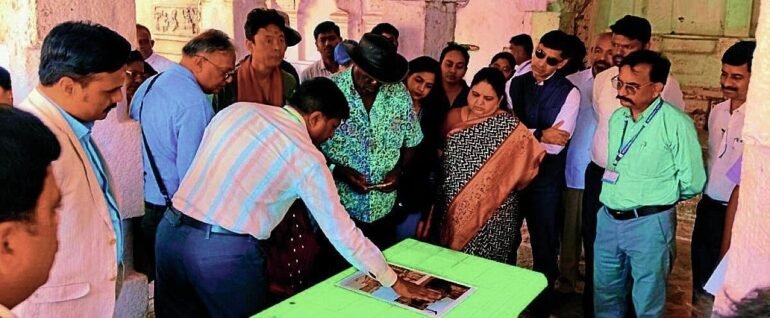
A UNESCO team inspecting the condition of monuments in Hampi, Vijayanagara district, on Monday, the second day of their visit, praised the construction of a new bypass road from the Uddhanda Veerabhadra Temple to Kaddirampura. The team, which also inspected the Virupaksha Temple, Salu Mantapa, Eduru Basavanna Mantapa, Krishna Temple, and the vehicle parking area near the Ugra Narasimha Temple, expressed satisfaction upon seeing the bypass while heading towards Mahanavami Dibba. An official accompanying the team stated that the members were pleased to learn that vehicles not requiring entry into Hampi would now use this route to continue via Kaddirampura.
Professor George Abung, a representative of the UNESCO World Heritage Centre, and Ishida Shimoda, an expert from the International Council on Monuments and Sites (ICOMOS), advised local officials to free Hampi from vehicle congestion and implement a more scientific parking system. They noted that parking near the Salu Mantapa in front of the Virupaksha Temple is inappropriate and recommended relocating it to another area. District Collector Kavitha S. Mannikere and Archaeological Survey of India (ASI) Superintending Archaeologist K. Ramakrishna Reddy provided information to the team.
During a stakeholder meeting held on Sunday evening at the District Collector’s office, UNESCO experts emphasized the need for sustainable development of heritage sites that includes local communities. They warned that excluding locals from heritage sites turns them into ‘dead sites,’ a phenomenon observed in various parts of the world, and stressed that Hampi must avoid this fate. ASI Additional Director General Janviji Sharma noted that Hampi was declared a World Heritage Site in 1986 and the first Integrated Management Plan (IMP) was prepared in 2006. He added that a new IMP is currently being drafted based on the 1972 Convention to develop Hampi as a living cultural site.
District Collector Kavitha S. Mannikere assured that all opinions and suggestions from the meeting would be compiled and submitted to the Forest Department, ASI, UNESCO, and ICOMOS. She promised that the new IMP would maintain a proper balance between the conservation of Hampi and the livelihood of local residents. Key demands raised before UNESCO include opportunities for agri-tourism and farm stays to curb migration, a ropeway and emergency medical facility at Anjanadri, development of Kamalapur Lake, a separate hospital, auto stand, and sanitation system, priority for the ‘Night Hampi’ proposal, designated spaces and guidelines for women’s self-help groups, auto drivers, and guides, and improved road connectivity to lesser-known temples in and around Hampi.