
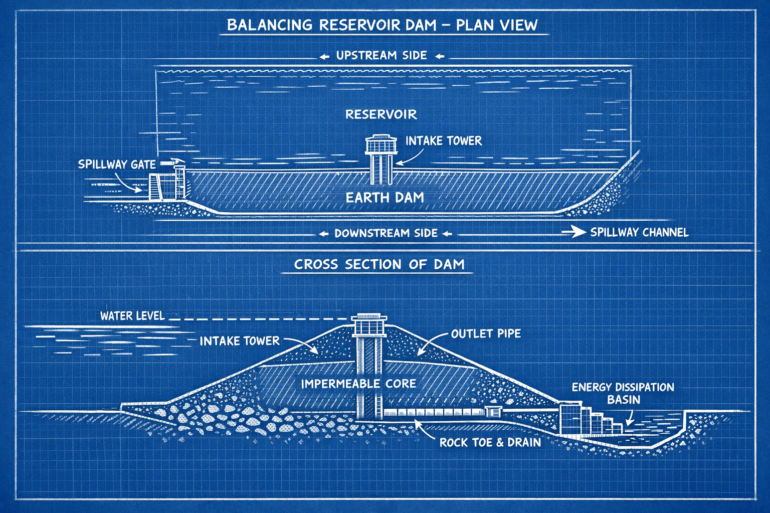
More than 30 tmcft of silt accumulation in the Tungabhadra reservoir has renewed discussion on constructing the proposed Navali balancing reservoir to compensate for the loss of storage capacity.
The proposed balancing reservoir near Navali village in Koppal district was once again mentioned in the State Budget, continuing a pattern in which the project is repeatedly highlighted in budget speeches but has made little progress on the ground.
While presenting the Budget in the Legislative Assembly on March 6, Chief Minister Siddaramaiah said the government was examining alternative solutions to address the declining storage capacity of the Tungabhadra reservoir caused by decades of silt deposition. One option under consideration is to build a balancing reservoir near Navali in Koppal district.
According to the Budget, efforts will be stepped up to implement a suitable alternative plan after consultations with neighbouring states Andhra Pradesh and Telangana, along with the approval of the Tungabhadra Board.
The reservoir project has been proposed as a long-term solution to compensate for the gradual reduction in storage capacity at the Tungabhadra reservoir near Hosapete in Vijayanagara district. Over the years, significant silt deposits have accumulated on the reservoir bed, reducing the volume of water that can be stored for irrigation purposes.
Estimates indicate that more than 30 tmcft of silt has built up in the reservoir over several decades, lowering the dam’s storage capacity and impacting water availability in the irrigation command areas.
Farmers in Raichur, Koppal, Ballari and Vijayanagara districts, which rely heavily on Tungabhadra waters for irrigation, have long been urging the government to address the issue either by removing the silt from the reservoir or by creating additional storage to make up for the lost capacity.
However, desilting a large reservoir like Tungabhadra has been considered technically challenging and financially impractical. As a result, constructing a balancing reservoir near Navali has been suggested as an alternative approach to restore the lost storage capacity.
The proposal also involves inter-State considerations. The Tungabhadra, a tributary of the Krishna river, forms part of an inter-State irrigation system. The Tungabhadra reservoir is jointly managed by Karnataka, Andhra Pradesh and Telangana. Therefore, any proposal to construct a new reservoir requires consultations with the neighbouring states as well as approval from the Tungabhadra Board, which includes representatives from the three states and is chaired by an appointee of the Union government.

Despite these complexities, the plan to build a balancing reservoir near Navali has been mentioned in multiple budgets over the years. However, it has largely remained at the announcement stage, with no clear allocation of funds or timeline for implementation.
Leaders of farmers’ groups in the Tungabhadra command area say that repeated references to the project in budget speeches without visible action have raised doubts about the commitment of successive governments to take it forward.
Chamarasa Malipatil, a farmers’ leader from Raichur familiar with the issue, said the proposal had been repeatedly announced but little progress had been seen on the ground.
“For several years now, governments have been repeating the announcement about constructing the Navali Balancing Reservoir in their budget speeches, but there has been no movement on the ground. The people’s representatives from the region, irrespective of party affiliation, should feel ashamed. They have been using this issue only for electoral gains. Earlier, both Congress and BJP governments had prepared detailed project reports, and now the Siddaramaiah government is again saying it will consult Telangana and Andhra Pradesh. I do not know how many more years the government plans to spend merely consulting and discussing the project,” Mr. Malipatil told reporters.