
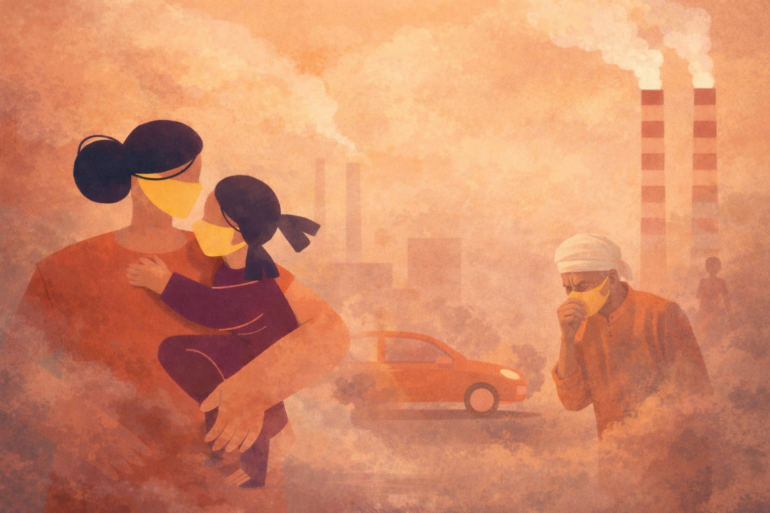
If you have stepped outside in Hospet this week and felt a heaviness in the air, the data backs up that feeling. April 2026 has started as one of the more polluted Aprils the city has seen in recent years, and a five-year comparison of air quality readings suggests this is not a one-off problem.
According to historical data from aqi.in, Hospet’s Air Quality Index (AQI) opened this month at around 90, higher than most previous years for the same period. By April 7, it had eased to around 68. That decline might sound like good news, but health experts caution that even this “moderate” range is not safe for everyone. The elderly, young children, and anyone with asthma or other respiratory conditions remain at risk even when AQI stays between 60 and 90.
What Five Years of April Data Shows
Looking at April AQI readings from 2022 through 2026, a few patterns stand out. Every single year, the first week of April records some of the highest pollution levels of the month. In 2023 and 2024, mid-month spikes pushed AQI past 130, a level classified as unhealthy for sensitive groups. Across all five years, AQI has rarely dipped below 50, the threshold considered good, for any meaningful stretch of time. And 2026 is tracking at or above the upper range of previous years, not below it.
Why April Is Particularly Bad
April sits squarely in Hospet’s dry pre-monsoon season. With no rain to wash pollutants out of the air, dust from roads and construction, particulate matter from iron ore handling, and industrial emissions from the city’s steel belt all accumulate freely.
Hospet lies at the heart of one of India’s most active iron ore mining and steel production corridors. The Kalyani Steels plant in Ginigera operates blast furnaces, basic oxygen furnaces, and direct reduced iron technology, all of which generate significant particulate emissions. These do not go away between shifts. They linger in still, dry air exactly like the kind Hospet sees every April.
The main pollutant driving Hospet’s poor readings is PM2.5, with current concentrations running at more than five times the World Health Organization’s annual guideline value. IQAir To put that plainly, the air most residents are breathing right now carries five times the fine particle load that international health standards consider acceptable over the long term.
What This Means for Residents
On days when AQI crosses 100, which has happened repeatedly every April since 2022, sensitive groups should avoid prolonged time outdoors, especially during morning hours when particulate levels tend to peak. Even on moderate days like today, people with breathing difficulties, heart conditions, or compromised immunity should limit strenuous outdoor activity and keep windows closed during peak traffic and industrial hours.

The Deeper Problem
Hospet’s air quality challenge is not going to fix itself. The city has no ground-level air monitoring stations of its own. All available data is modelled from satellite readings, with zero government, corporate, or individual monitoring contributors on the ground. IQAir That means the actual air quality experienced at street level could be worse than what any chart shows.
Industrial growth in Vijayanagara district is welcome. But the people living and breathing in its shadow deserve accurate data, stricter emission controls, and at minimum, a real monitoring station in the city. Until then, residents are making health decisions based on satellite estimates rather than ground truth.
Hospet.online will continue tracking air quality through April. Live AQI readings are available at aqi.in and iqair.com.