
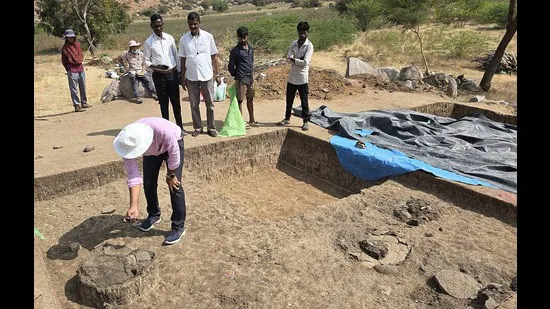
Two prehistoric human skeletons have been unearthed in Karnataka’s Ballari district, with researchers identifying clear signs of a burial custom that involved placing stones over the bodies, shedding light on the social and cultural practices of the time.
The remains were discovered during an ongoing excavation at Gaudra Moole Hill in Tekkalakote town. The project is led by Dr. Namita S. Sugandhi, a professor at Hartwick College in the United States and co-director of the excavation.
Human bones were first noticed beneath the soil last week. Continued excavation revealed two complete skeletons, each around 5.5 feet long, positioned side by side.
The skeletons were found in a notably well-preserved state. Evidence of stones deliberately placed over the bodies suggests a structured burial practice, offering important insights into the customs of the period.
Pottery fragments, microlithic tools, and traces of early tool use were also recovered from the site. These discoveries indicate that Tekkalakote may have been a significant human settlement during the Neolithic or prehistoric era.
Experts believe the remains could be between 3,000 and 5,000 years old. Carbon dating tests will be conducted to establish their exact age. R. Shajeswar, Deputy Director of the State Archaeology Department and director of the excavation, visited the site to review the findings.
He emphasized that preserving such a rare archaeological site for future generations is a shared responsibility.

Dr. Sugandhi first carried out excavation work in Tekkalakote in 2019.
She returned in 2025 to prepare a research paper and presented a study titled Man and Environment: Tekkalakote. She is currently undertaking her third excavation at the site.
Earlier, in 1964, renowned archaeologist M.S. Nagaraja Rao conducted excavations in Tekkalakote, drawing international attention to the area’s historical importance. His work inspired Dr. Sugandhi to pursue research at the site.