
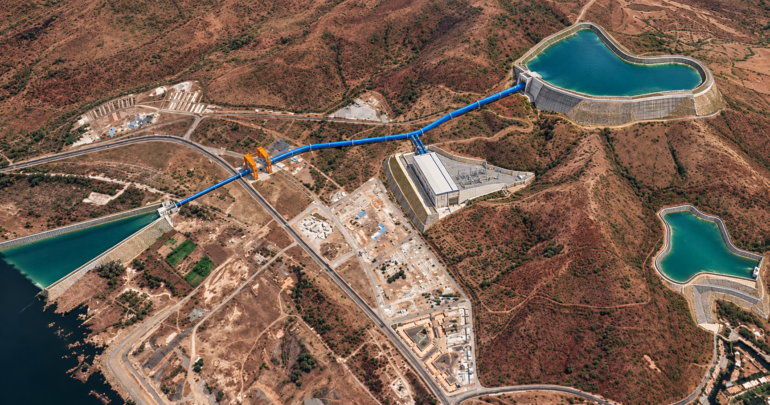
The Expert Appraisal Committee (EAC) of the Ministry of Environment, Forest and Climate Change (MoEFCC) has given its first-stage approval, subject to conditions, for JSW Energy PSP Three Limited’s 300 MW Narihalla Pumped Storage Project (PSP) near Taranagar and Shankarapur villages in Sandur taluk. The ₹2,215 crore project will use the existing Narihalla reservoir as the lower reservoir and a new reservoir near Taranagar as the upper reservoir. It will require 111.10 hectares of land, including 39.255 hectares of forest land, 10.47 hectares of government land, 31.754 hectares of NHP land and 29.622 hectares of private land. The project will have an underground power station with two 150 MW turbines and is expected to generate 832.20 million units of electricity annually. The approval was given at the EAC meeting held on September 15.
The project was initially approved in principle by the Karnataka government on November 28, 2022, for JSW Neo Energy Limited, with a proposed capacity of 557 MW. On July 4, 2025, the government reduced the proposed capacity to 300 MW and transferred the approval to JSW Energy PSP Three Limited.
The project will require around 500 kilolitres of water every day during construction, which will be sourced from the Narihalla reservoir. Once operational, around 8 million cubic metres (MCM) of water will be required to initially fill the upper reservoir. The project is expected to require about 0.46 MCM of water annually during operation.
The project has also made provisions for periods of severe drought or water shortage. If sufficient water is not available from Narihalla, an intake and pumping station could be constructed near Kampli to draw water from the Tungabhadra river. The water would then be transported to the project through a 48-km-long pipeline.
The EAC has specifically stressed that water reserved for irrigation must not be diverted for power generation under any circumstances. It has also called for a detailed study on the possible impact of drawing water from the Tungabhadra river.
Since the project involves the use of forest land, several conditions will have to be met before it can proceed. These include obtaining the required first-stage forest clearance from the Union Ministry, submitting 10 years of water availability data, implementing an extensive plantation programme using indigenous tree species, and preparing plans for managing soil and excavation waste.

The committee has also sought an assessment of the project’s possible impact on fisheries and aquatic ecosystems.
According to the project documents, no families will need to be relocated as the project is not expected to cause any displacement.